Breaking down on a motorway represents one of the most stressful situations any driver can face. The combination of high-speed traffic, limited options for stopping safely, and the immediate need for decisive action creates a uniquely challenging scenario. Understanding the correct procedures when you find yourself broken down on motorway routes can mean the difference between a manageable inconvenience and a dangerous situation. This comprehensive guide outlines the essential steps, safety protocols, and professional assistance options available to drivers across Greater London and the Home Counties.
Understanding Motorway Breakdown Risks
Motorway breakdowns occur far more frequently than many drivers anticipate. Research indicates that certain sections of England’s motorway network experience particularly high breakdown rates, with the M25 topping the list of England’s motorway breakdown hotspots. The combination of heavy traffic volumes, extended journey distances, and continuous high-speed operation places considerable strain on vehicle components.
Why Motorways Present Unique Challenges
Unlike urban roads or A-roads, motorways eliminate the luxury of time when mechanical failures occur. Vehicles travel at speeds up to 70mph, reducing reaction times dramatically. The hard shoulder, where available, provides limited protection, whilst smart motorway sections without permanent hard shoulders create additional complexity for stranded drivers.
Key risk factors include:
- Traffic density: Greater London motorways experience some of the highest traffic volumes in the UK
- Vehicle speed: Fast-moving traffic reduces safety margins significantly
- Limited exit options: Motorway junctions may be several miles apart
- Weather conditions: Rain, fog, and darkness compound visibility issues
- Driver awareness: Studies show three quarters of drivers unknowingly put themselves in danger during motorway breakdowns

Immediate Actions When Your Vehicle Fails
The first sixty seconds after experiencing mechanical problems determine your safety outcome. When you realise your vehicle is failing, immediate and correct actions become paramount. Panic serves no purpose; systematic response does.
Step-by-Step Emergency Response
- Activate hazard warning lights immediately – This alerts following traffic to your difficulty
- Maintain speed if possible – Continue to the next exit or emergency refuge area
- Move to the hard shoulder – If continuation proves impossible, pull left as safely as traffic permits
- Position as far left as achievable – Maximum distance from live traffic lanes
- Exit from the passenger side – Never exit into traffic
- Move behind the barrier – Distance yourself from your vehicle and live carriageway
These actions align with official UK government guidelines for handling breakdowns, which provide legally required procedures for all motorway users.
The Motors Recovery offers comprehensive advice on motorway breakdown procedures, emphasizing that personal safety supersedes vehicle protection in every scenario.
Smart Motorway Considerations
Smart motorways introduce additional complexities for drivers who find themselves broken down on motorway sections without traditional hard shoulders. These managed motorways use technology to control traffic flow, but they also present heightened risks during breakdowns.
| Smart Motorway Type |
Hard Shoulder Status |
Emergency Refuge Distance |
Risk Level |
| All Lane Running |
None – converted to live lane |
Up to 1.5 miles apart |
Highest |
| Dynamic Hard Shoulder |
Part-time use during peak hours |
Variable availability |
Medium-High |
| Controlled Motorway |
Permanent hard shoulder |
Standard motorway spacing |
Standard |
Evidence suggests that breakdown risk on smart motorways is four times higher than conventional roads, particularly when emergency refuge areas remain beyond reach. This statistical reality underscores the importance of vehicle maintenance and breakdown preparation.
Reaching Emergency Refuge Areas
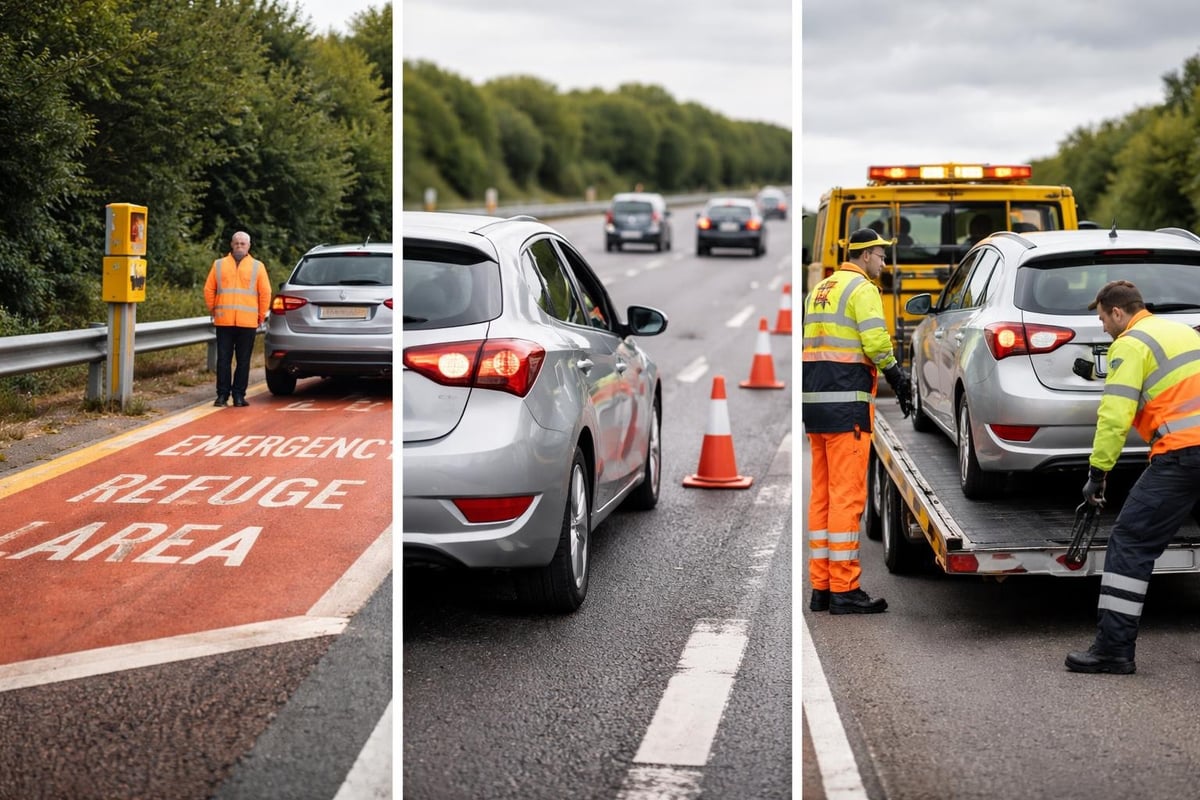
Emergency refuge areas (ERAs) appear every 1.5 miles on average across smart motorway sections. These dedicated stopping points provide:
- Orange-surfaced layby areas clearly marked with blue signage
- Emergency telephones connecting directly to Highways England
- CCTV monitoring for rapid incident response
- Relative safety compared to stopping in live lanes
If you cannot reach an ERA:
- Move to the leftmost lane if safe
- Stop as far left as possible
- Activate hazard lights
- Exit via passenger doors if safe
- Call 999 immediately
- Call Motors Recovery Services
- Do not attempt repairs
- Do not retrieve items from the vehicle
Essential Safety Equipment and Preparation
Prevention and preparation significantly reduce the severity of motorway breakdown incidents. Every vehicle should carry specific equipment before embarking on motorway journeys, particularly during what the government identifies as breakdown season peak periods.
Mandatory and Recommended Equipment
Essential items:
- High-visibility jackets for all occupants
- Warning triangle (though placement on motorways is not recommended)
- Fully charged mobile phone
- Breakdown recovery service contact details
- Torch with spare batteries
- First aid kit
Recommended additions:
- Reflective road flares or beacons
- Drinking water and non-perishable snacks
- Blankets for cold weather
- Portable phone charger
- Basic tool kit
Pre-Journey Vehicle Checks
Conducting systematic pre-journey checks reduces breakdown probability substantially. Focus on these critical areas:
- Tyre condition and pressure – Including spare tyre verification
- Fluid levels – Oil, coolant, brake fluid, windscreen wash
- Battery terminals – Clean connections, no corrosion
- Lights and indicators – All functions operational
- Fuel level – Sufficient for journey plus reserve
- Warning lights – Dashboard indicators functioning correctly
Protecting Yourself and Your Passengers
Personal safety takes absolute priority when broken down on motorway infrastructure. Vehicle recovery, insurance claims, and schedule disruptions pale in comparison to life-threatening risks posed by high-speed traffic.
Passenger Safety Protocol
Once you’ve stopped, immediate passenger management becomes critical:
Inside the vehicle:
- Keep all passengers seated with seatbelts fastened until safe exit is confirmed
- Assess traffic conditions before opening any door
- Identify the safest exit point (always away from traffic)
- Prepare children and vulnerable passengers for swift exit
Exiting the vehicle:
- Exit exclusively via passenger-side doors
- Move quickly but carefully behind safety barriers
- Climb the embankment if terrain permits
- Position yourselves well away from the carriageway
- Never stand between your vehicle and live traffic
Research from The AA examining drivers’ responses during breakdowns reveals concerning gaps between recommended actions and actual driver behaviour, highlighting the importance of advance knowledge.
| Action |
Recommended |
Common Practice |
Risk Level |
| Exit vehicle immediately |
Yes (when safe) |
47% remain inside |
High |
| Move behind barrier |
Always |
62% comply |
Critical |
| Wear hi-vis jacket |
Yes |
38% use |
Medium |
| Call for help immediately |
Yes |
81% eventually call |
Variable |
Contacting Professional Recovery Services
Once you and your passengers are safe, securing professional recovery assistance becomes the next priority. The speed and quality of this response significantly impacts your overall experience and safety duration.
Recovery Service Selection Criteria
24-hour availability: Motorway breakdowns occur at any hour; recovery services must respond accordingly
Local knowledge: Familiarity with Greater London and Home Counties motorway networks ensures faster response times
Fleet capability: Modern recovery vehicles equipped for various vehicle types (cars, vans, motorcycles)
Technical expertise: Experienced technicians capable of roadside repairs when possible
Comprehensive service range: Battery jump-starts, towing, police pound recovery, and specialist assistance
Communication During Recovery
When contacting recovery services, provide:
- Exact motorway designation and direction of travel
- Nearest junction number or emergency marker post number
- Vehicle make, model, and colour
- Nature of the breakdown
- Number of passengers
- Any specific hazards or complications
Emergency marker posts appear every 100 metres on motorway hard shoulders, displaying unique location codes that pinpoint your position precisely.

Common Motorway Breakdown Scenarios
Understanding typical breakdown causes helps drivers recognise warning signs before complete failure occurs. Early recognition may provide sufficient time to exit the motorway safely.
Mechanical Failures
Engine overheating:
- Temperature gauge rising into red zone
- Steam emerging from bonnet
- Loss of power
- Dashboard warning lights
Tyre failure:
- Sudden pulling to one side
- Vibration through steering wheel
- Loud noise or bang
- Visible deflation
Electrical problems:
- Dashboard lights dimming
- Difficulty starting
- Warning light clusters
- Complete power loss
Transmission issues:
- Difficulty changing gears
- Slipping between gears
- Unusual noises during gear changes
- Inability to engage gears
Fuel-Related Problems
Running out of fuel represents one of the most preventable breakdown causes. Despite appearing obvious, fuel depletion accounts for a significant percentage of motorway incidents, particularly during extended journeys through unfamiliar areas.
Prevention strategies:
- Refuel when the tank reaches quarter-full
- Plan fuel stops before motorway entry
- Account for traffic delays in fuel calculations
- Monitor consumption rates during journey
- Recognise that motorway driving consumes fuel faster than urban driving
Legal Obligations and Insurance Implications
Drivers broken down on motorway infrastructure face specific legal requirements and potential insurance considerations that extend beyond immediate safety concerns.
Highway Code Requirements
The Highway Code stipulates precise actions for breakdown situations. Non-compliance may result in penalties or affect insurance claims. Key requirements include:
- Activating hazard warning lights
- Exiting the vehicle safely
- Moving away from the carriageway
- Not attempting repairs on the carriageway
- Not crossing motorway lanes on foot
Insurance Documentation
Following recovery, maintain comprehensive records:
- Recovery service receipt and job number
- Photographs of vehicle position (if safe to obtain)
- Witness contact details (if applicable)
- Incident reference number from recovery operator
- Detailed notes regarding breakdown cause and circumstances
Vulnerable Situations and Special Circumstances
Certain scenarios compound the already challenging nature of motorway breakdowns, requiring modified approaches and heightened caution.
Night-Time Breakdowns
Darkness dramatically reduces visibility for both stranded drivers and passing traffic. Additional precautions include:
- Ensuring high-visibility clothing is worn before exiting
- Using torches to illuminate your position
- Remaining extra vigilant regarding approaching traffic
- Avoiding any unnecessary movement near the carriageway
Adverse Weather Conditions
Rain, fog, ice, and high winds create additional hazards. These conditions reduce other drivers’ reaction times and visibility, whilst making your own movements more hazardous.
Breakdowns with Children or Pets
Families travelling with children or pets face additional challenges:
- Prioritise child safety over belongings
- Carry children who cannot walk independently
- Keep pets on leads and under control
- Use car seats as carrying devices if necessary
- Consider children’s limited understanding of danger
Solo Driver Situations
Drivers travelling alone should:
- Inform someone of breakdown situation and location
- Remain especially vigilant regarding personal security
- Stay in mobile phone contact with recovery service
- Exercise caution when approached by unknown individuals
- Trust professional recovery services rather than accepting lifts
Post-Breakdown Vehicle Assessment
Once your vehicle reaches safety, whether at home or a garage, comprehensive assessment determines the repair pathway and identifies underlying causes.
Diagnostic Requirements
Professional technicians should examine:
Immediate failure cause:
- Component that precipitated breakdown
- Whether failure occurred suddenly or progressively
- Any warning signs that preceded complete failure
Secondary issues:
- Related components showing wear
- Systems affected by primary failure
- Preventative maintenance requirements
Safety verification:
- Brake system integrity
- Tyre condition across all wheels
- Fluid levels and quality
- Electrical system functionality
- Steering and suspension components
Maintenance Schedule Review
Breakdowns often reveal lapses in routine maintenance. Use the incident to:
- Review manufacturer service schedules
- Address overdue maintenance items
- Establish regular inspection routines
- Consider upgrading older components proactively
- Document all service work comprehensively
Prevention Strategies and Long-Term Planning
The most effective breakdown management strategy remains prevention. Systematic vehicle care and driving practices significantly reduce motorway breakdown probability.
Regular Maintenance Programme
Establish and maintain:
- Annual professional servicing
- Monthly visual inspections
- Weekly fluid level checks
- Daily dashboard warning light monitoring
- Immediate attention to unusual sounds, smells, or behaviour
Journey Planning
Before motorway travel:
- Check weather forecasts and traffic conditions
- Verify vehicle fuel sufficiency
- Confirm mobile phone charge
- Review route including junction numbers
- Identify alternative routes
- Allow extra time for unexpected delays
Driver Education and Awareness
Knowledge gaps contribute substantially to breakdown dangers. The AA’s research into drivers’ awareness of breakdown procedures reveals concerning deficiencies in understanding correct responses.
Educational priorities include:
- Correct motorway breakdown procedures
- Smart motorway specific protocols
- Emergency refuge area locations and usage
- Recovery service contact procedures
- Personal safety priorities
Drivers should also familiarise themselves with breakdown scenario rankings to understand which situations present greatest challenges and prepare accordingly.
Recovery Service Partnership Benefits
Establishing relationships with professional recovery services before emergencies occur provides multiple advantages over reactive approaches during crisis situations.
Pre-Breakdown Service Selection
Evaluation criteria:
- Geographic coverage matching your travel patterns
- Response time commitments
- Fleet size and vehicle specifications
- Technician qualification levels
- Customer service reputation
- Pricing transparency
- Additional service offerings
Ongoing Service Relationships
Regular customers of established recovery services benefit from:
- Faster response through account recognition
- Service history awareness
- Established payment arrangements
- Priority scheduling during peak periods
- Relationship continuity with familiar technicians
Understanding what to do when broken down on motorway infrastructure transforms a potentially catastrophic situation into a manageable incident. The combination of correct immediate actions, proper safety equipment, and professional recovery support ensures both personal safety and efficient vehicle recovery. When you need reliable assistance across Greater London and the Home Counties, Motors Recovery provides 24-hour breakdown recovery services with experienced technicians and modern recovery vehicles ready to respond swiftly, ensuring you receive professional support exactly when you need it most.

